Document Type : Original Research Articles
Authors
1
The Persian Gulf Tropical Medicine Research Center, The Persian Gulf Biomedical Sciences Research Institute, Bushehr University of Medical Sciences, Bushehr, Iran.
2
Department of Medical Education, Education Development Center, Bushehr University of Medical sciences, Bushehr, Iran.
3
Department of Anatomical Sciences, School of Medicine, Bushehr University of Medical Sciences, Bushehr, Iran.
4
Student Research Committee, Bushehr University of Medical Sciences, Bushehr, Iran.
Abstract
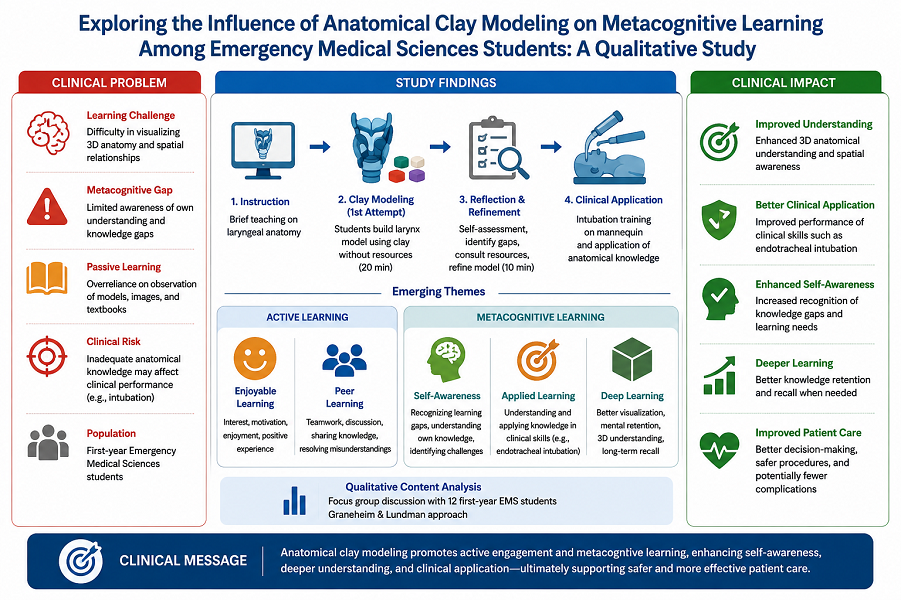
Background: Anatomy education requires students to develop accurate three-dimensional mental representations of complex anatomical structures. However, many learners experience difficulties in visualizing spatial relationships and evaluating the depth of their own understanding. Metacognitive skills, including awareness and regulation of learning processes, are essential for effective and lifelong learning. This study aimed to explore students’ experiences of anatomical clay modeling and its perceived contribution to active and metacognitive learning among Emergency Medical Sciences students.
Methods: This qualitative study was conducted among 12 first-year Emergency Medical Sciences students at Bushehr University of Medical Sciences. Participants engaged in an anatomy-based educational intervention using colored modeling clay to construct a three-dimensional model of the larynx. Data were collected through a semi-structured focus group discussion and analyzed using qualitative content analysis based on the Graneheim and Lundman approach.
Results: Qualitative analysis of the interview data revealed two overarching themes: Active Learning and Metacognitive Learning. These themes included five categories: enjoyable learning, peer learning, self-awareness, applied learning, and deep learning. Participants reported that the modeling activity promoted engagement, facilitated peer interaction, increased awareness of knowledge gaps, supported clinical application of anatomical knowledge, and enhanced three-dimensional understanding and knowledge retention.
Conclusion: Anatomical clay modeling represents a learner-centered educational approach that supports active engagement and metacognitive learning in anatomy education. By encouraging students to construct, evaluate, and refine their anatomical representations, this approach may enhance self-awareness, deeper understanding, and long-term retention of knowledge.
Implications for Patient Care: Integrating anatomy-based modeling and metacognitive learning strategies into healthcare education may strengthen learners’ clinical competency by improving three-dimensional anatomical understanding, self-awareness, and the ability to apply knowledge during clinical procedures. Such educational approaches may contribute to preparing future healthcare professionals for safer and more effective clinical practice.
Graphical Abstract
Keywords
Subjects