Document Type : Original Research Articles
Authors
1
Intensive Care Nursing Graduate, Lorestan University of Medical Sciences, Khorramabad, Iran.
2
Department of Medical -Surgical Nursing, School of Nursing and Midwifery, Social Determinants of Health Research Center, Lorestan University of Medical Sciences, Khorramabad, Iran.
3
Surgical Technology Department, Faculty of Paramedical, Lorestan University of Medical Sciences, Khorramabad, Iran.
4
Department of Biostatistics and Epidemiology, Faculty of Health and Nutrition, Lorestan University of Medical Sciences, Khorramabad, Iran.
Abstract
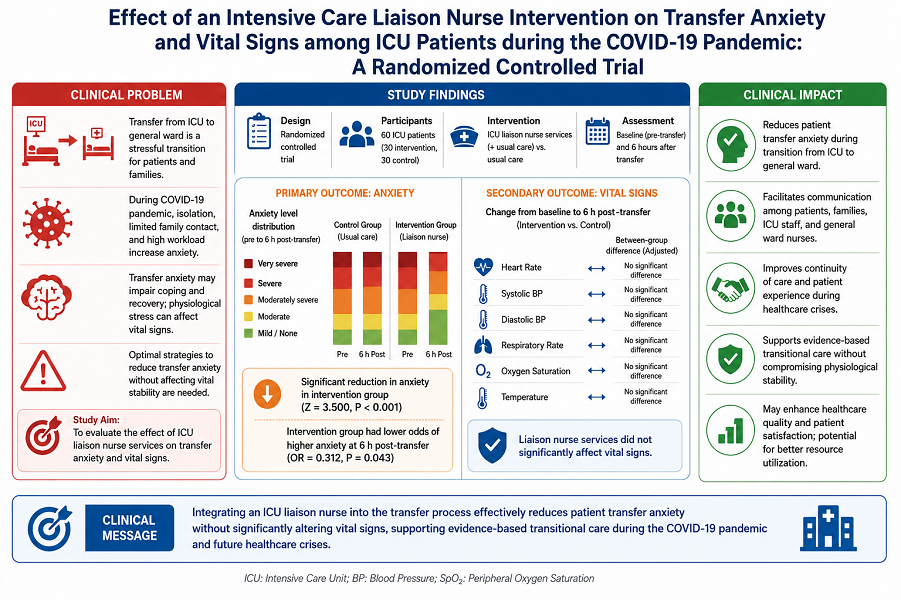
Background: Transfer of patients from the intensive care unit (ICU) to a general ward can be a stressful process for patients and their families. This study aimed to evaluate the effect of intensive care liaison nurse services on patients’ transfer anxiety and vital signs during the COVID-19 pandemic.
Materials and Methods: This randomized controlled trial was conducted from January 2020 to August 2021. Sixty patients were randomly assigned to the control (n=30) and intervention (n=30) groups. The control group received usual care, whereas the intervention group received intensive care liaison nurse services, including patient and family support, staff training, and assessment of the destination ward. Anxiety was assessed using the Spielberger State-Trait Anxiety Inventory immediately after transfer and 6 hours after transfer. Data were analysed using descriptive and inferential statistics, including paired t-test, Wilcoxon signed-rank test, one-way ANOVA, analysis of covariance, and a generalized linear model with a cumulative logit link function.
Results: There were no significant between-group differences in demographic characteristics. After adjusting for baseline values, no statistically significant differences were observed between the groups in changes in vital signs. In the control group, the distribution of anxiety levels did not change significantly from baseline to the end of the study, whereas a significant reduction was observed in the intervention group (Z = 3.500, P < 0.001).
Conclusions: Intensive care liaison nurse services were effective in reducing patients’ transfer anxiety but did not significantly affect vital signs. Further studies with larger sample sizes are needed to confirm these findings.
Implications for Patient Care: ICU liaison nurse services may help reduce patients’ transfer anxiety during transition from the ICU to the general ward, particularly during healthcare crises, although they may not significantly affect vital signs.
Graphical Abstract
Keywords
Subjects