Document Type : Original Research Articles
Authors
1
Department of Obstetrics and Gynecology, School of Medicine, Shahid Rahimi Hospital, Lorestan University of Medical Sciences.
2
Student Research Committee, Lorestan University of Medical Sciences, Khorramabad, Iran.
3
School of Global Studies, Oklahoma State University, Stillwater, Oklahoma, USA.
4
Department of Pharmacognosy, Faculty of Pharmacy, Lorestan University of Medical Sciences, Khorramabad, Iran.
5
Department of Pharmacognosy, School of Pharmacy, Islamic Azad University, Ayatollah Amoli Branch, Amol, Iran.
6
Department of Social Medicine, School of Medicine, Lorestan University of Medical Sciences, Khorramabad, Iran.
Abstract
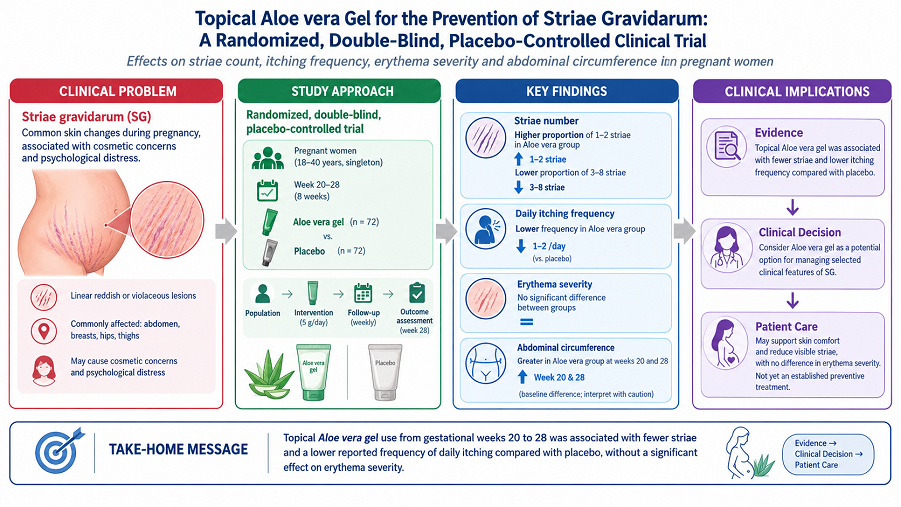
Background: Striae gravidarum are common pregnancy-associated skin changes, and effective topical interventions remain insufficiently established. Aloe vera has potential skin-hydrating and anti-inflammatory properties. This study evaluated the effects of topical Aloe vera gel on striae count, daily itching frequency, and erythema severity during pregnancy.
Methods: This randomized, double-blind, placebo-controlled trial included 144 primigravid women with singleton pregnancies and no abdominal striae at baseline. Participants received topical Aloe vera gel or placebo (72 per group), applying approximately 5 g daily to the abdomen from gestational weeks 20 to 28. At week 28, striae count (1–2 or 3–8), daily itching frequency (1–2, 3–4, or 5–6 episodes), and erythema severity were assessed. Abdominal circumference was measured at weeks 20 and 28.
Results: Striae count categories differed significantly between groups (χ² = 26.70, P < 0.001). The proportion with 1–2 striae was 70.8% in the Aloe vera group and 27.8% in the placebo group. Itching frequency also differed significantly (χ² = 18.06, P < 0.001), with 59.7% and 25.0%, respectively, reporting itching 1–2 times daily. Erythema severity did not differ significantly (χ² = 3.606, P = 0.307). Abdominal circumference was greater in the Aloe vera group at weeks 20 and 28; however, the baseline difference limits interpretation of the follow-up comparison.
Conclusion: Topical Aloe vera use was associated with a more favorable distribution of striae counts and lower itching frequency, but not significantly different erythema severity. Further trials are needed to confirm these findings.
Implications for Patient Care: Topical Aloe vera gel may help reduce striae count and itching frequency during pregnancy, but further trials are needed before it can be recommended as an established preventive treatment for striae gravidarum.
Graphical Abstract
Keywords
Subjects