Nexus of Integrated Clinical Science (NICS) is an international, peer-reviewed, open-access journal publishing multidisciplinary research across clinical and health sciences, with a focus on evidence-based practice, patient care, healthcare delivery, and health outcomes.
Lower Limb Anthropometry and Stature Estimation: Development of Regression Models in an Iranian Adult Population

Document Type : Original Research Articles

Authors

1 The Persian Gulf Tropical Medicine Research Center, The Persian Gulf Biomedical Sciences Research Institute, Bushehr University of Medical Sciences, Bushehr, Iran.

2 Department of Anatomical Sciences, School of Medicine, Bushehr University of Medical Sciences, Bushehr, Iran.

3 Addiction and Lifestyle Research Center, Bushehr University of Medical Sciences, Bushehr, Iran.

4 Department of Biostatistics and epidemiology, Bushehr University of Medical Sciences, Bushehr, Iran.

Abstract
Background: Stature estimation is a fundamental component of biological profiling in forensic anthropology, particularly when conventional identification methods are unavailable. Because anthropometric relationships vary across populations, population-specific regression equations are required for accurate stature estimation. This study investigated the association between lower limb anthropometric measurements and stature and developed regression models for stature estimation in an Iranian adult population.
Materials and Methods: In this descriptive cross-sectional study, 218 indigenous adults were recruited from Bushehr, Iran. Thigh length, leg length, foot length, lower limb length, and stature were measured using standardized anthropometric methods. Pearson’s correlation coefficient, the independent samples t-test, and multiple linear regression models were employed for data analysis.
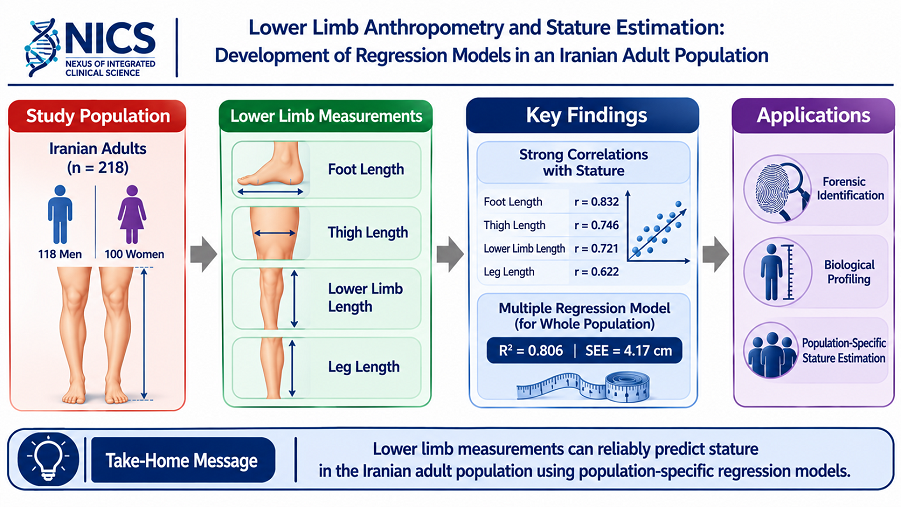
Results: The mean age of participants was 33 years. All lower limb measurements were significantly correlated with stature (P<0.001). Foot length demonstrated the strongest correlation with stature (r=0.832), followed by thigh length (r=0.746), lower limb length (r=0.721), and leg length (r=0.622). No significant difference was found between measured and estimated stature.
Conclusion: Foot length showed the strongest association with stature among lower-limb measurements, making it the most useful predictor for stature estimation and forensic identification in the Bushehr indigenous population.
Implications for Patient Care: Population-specific lower-limb anthropometric measurements can provide supplementary information for stature estimation when direct measurement is not possible. The regression equations developed in this study may assist forensic professionals in estimating stature from available lower-limb measurements. These findings may support the identification of individuals with incomplete or fragmented human remains. The proposed equations should be used alongside other forensic evidence to improve the identification process.

Graphical Abstract

Lower Limb Anthropometry and Stature Estimation: Development of Regression Models in an Iranian Adult Population

Keywords

Subjects