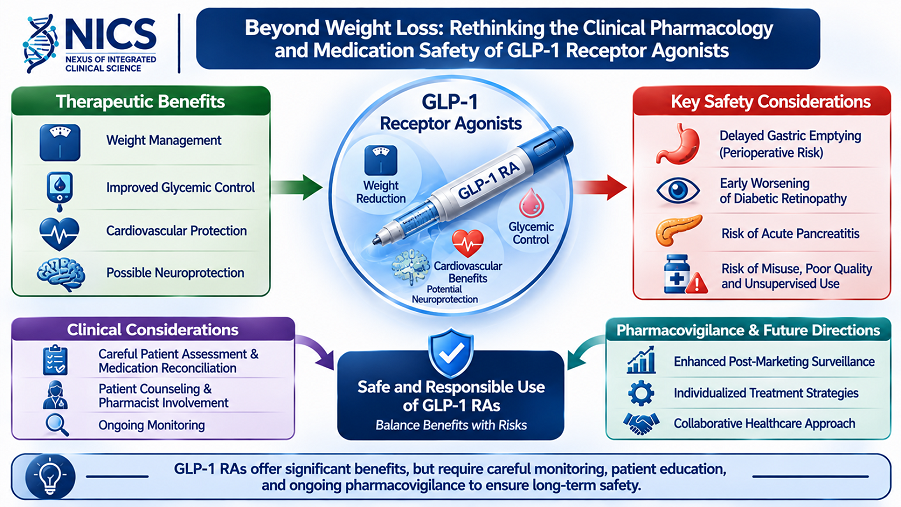
Dear Editor,
The clinical use of glucagon-like peptide-1 receptor agonists (GLP-1 RAs) has expanded considerably in recent years. These medications have become important options for the management of type 2 diabetes and obesity. Their effects on glycemic control, appetite regulation, and body weight have contributed to their increasing use in clinical practice. Evidence of cardiovascular and other metabolic benefits has further increased interest in this drug class. Emerging evidence suggests that GLP-1 receptor signaling may also contribute to peripheral neuroprotection by modulating neuroinflammation and neuronal function (1). However, wider use also brings new challenges. Appropriate prescribing, medication safety, and long-term monitoring deserve greater attention, particularly as GLP-1 RAs are increasingly used in different clinical settings and patient populations. One important concern relates to the use of these medications outside established indications or without adequate medical supervision. The growing demand for weight-loss treatments has increased interest in obtaining GLP-1 RAs through different prescribing and distribution channels. In this context, The World Health Organization has highlighted the growing threat of substandard and falsified medicines and emphasized the importance of effective pharmacovigilance and post-marketing safety surveillance (2). These issues are relevant to everyday clinical practice. Patients who obtain these medications without appropriate assessment may receive unsuitable doses or lack adequate follow-up. In addition, uncertainty about product quality and storage conditions may introduce further safety concerns. Therefore, access to these medications should be accompanied by reliable pharmaceutical supply chains and appropriate clinical supervision.
Beyond issues related to prescribing and product quality, the pharmacological effects of GLP-1 RAs require attention during routine patient care. Delayed gastric emptying is one of the recognized effects of this drug class. Although this action contributes to some of their metabolic effects, it may also have clinical implications. Retained gastric contents have been reported in patients receiving GLP-1 RAs, raising concerns about the potential risk of aspiration during general anesthesia and certain gastrointestinal procedures (3). The extent of this risk may vary according to the specific medication, treatment duration, dose escalation, and individual patient characteristics. For this reason, healthcare professionals should obtain an accurate medication history before planned procedures and consider current clinical recommendations when assessing perioperative management (4). Changes in glycemic control also deserve consideration. In some patients with diabetes, substantial and relatively rapid improvements in blood glucose levels may be accompanied by early worsening of pre-existing diabetic retinopathy. This issue has been discussed particularly in relation to semaglutide and highlights the importance of considering baseline retinal status in patients at increased risk. It does not necessarily indicate a direct toxic effect on the retina. Rather, the relationship between the magnitude of glycemic improvement and retinal changes should be considered when treatment is initiated or intensified (5). Such considerations support individualized treatment decisions and appropriate ophthalmological follow-up.
Another safety issue concerns acute pancreatitis. Although this event is uncommon, reports of pancreatitis have led to continued regulatory attention (6). Recent updates to prescribing information have emphasized the need to recognize symptoms suggestive of this condition, including persistent and severe abdominal pain. Reports of severe and necrotizing pancreatitis further reinforce the importance of clinical vigilance (7). Nevertheless, suspected adverse reactions should be evaluated carefully, and individual reports should not automatically be interpreted as evidence of a causal relationship. Clinical assessment remains necessary to distinguish medication-related events from other possible causes.
GLP-1 receptor agonists, combined with clear patient education and individualized counseling, may help address common misconceptions and support more appropriate medication use (8). Clinicians and pharmacists should specifically ask about GLP-1 RA use, including medications obtained through online services or private prescribing channels. The medication name, indication, dose, treatment duration, and recent dose changes should be documented whenever possible. Gastrointestinal symptoms, concomitant medications, and relevant medical conditions should also be considered. This information may help identify patients who require closer monitoring or further assessment. The role of pharmacists is particularly relevant in this context. Patients may have questions about dose escalation, missed doses, gastrointestinal adverse effects, and the appropriate duration of treatment. Clear counseling can help address these concerns and reduce the likelihood of inappropriate medication use. Pharmacists can also contribute to identifying potential drug-related problems and encouraging patients to seek medical advice when concerning symptoms develop. Such collaboration may be especially useful in patients receiving several medications or those with complex clinical conditions. In parallel, stronger pharmacovigilance activities are needed to improve the understanding of the safety profile of GLP-1 RAs under real-world conditions. Clinical trials provide essential information about efficacy and common adverse effects, but they may not fully represent the diversity of patients encountered in routine practice. Mechanistic clinical pharmacology approaches, including pharmacokinetic–pharmacodynamic modeling and biomarker-based assessment, may help characterize interindividual variability in therapeutic response and toxicity, supporting more individualized monitoring of GLP-1 RA therapy (9). Post-marketing surveillance plays an important role in identifying rare adverse events and detecting emerging safety signals that warrant further investigation (10). Consistent reporting of suspected adverse drug reactions is therefore important. Better communication between healthcare professionals, pharmacovigilance centers, and regulatory authorities may also facilitate the assessment of emerging safety concerns. Importantly, these activities should support evidence-based decisions rather than create unnecessary concerns about an entire therapeutic class.
Conclusion
The expanding use of GLP-1 RAs calls for an approach that considers both their therapeutic benefits and potential safety concerns. Appropriate patient selection, careful prescribing, medication reconciliation, and individualized monitoring remain important components of their clinical use. Collaboration between physicians, pharmacists, and regulatory authorities may further support medication safety and improve the quality of patient care. As the clinical applications of GLP-1 RAs continue to evolve, pharmacovigilance and responsible prescribing should remain integral to their use.
Implications for Patient Care
The increasing use of GLP-1 receptor agonists highlights the need for careful patient assessment and ongoing medication monitoring. Before initiating treatment, healthcare professionals should consider the patient's clinical condition, treatment indication, concomitant medications, and relevant risk factors. During treatment, attention should be given to gastrointestinal symptoms, dose escalation, and possible changes in glycemic control. Patients with pre-existing diabetic retinopathy may require appropriate ophthalmological assessment, particularly when substantial improvements in blood glucose levels are expected. In addition, patients scheduled for anesthesia or gastrointestinal procedures should inform their healthcare providers about GLP-1 RA use because delayed gastric emptying may have perioperative implications. Persistent or severe abdominal pain also warrants prompt clinical evaluation. Physicians and pharmacists can contribute to safer treatment through medication reconciliation, patient counseling, and reporting of suspected adverse drug reactions. These measures may support individualized treatment decisions and more appropriate use of GLP-1 RAs in routine clinical practice.
Conflict of Interest
The authors declared no conflicts of interest.
Funding
The authors received no specific funding for this work.
Ethics Statement
The authors confirm that all ethical principles of research and scientific publication, including plagiarism prevention, data integrity, and avoidance of duplicate publication, have been fully observed.
Data Availability Statement
No new data were generated or analyzed during this study. All information discussed in this review is available in the published literature cited in the manuscript.
Acknowledgments
The authors gratefully acknowledge the institutional support and resources provided by the Irma Lerma Rangel School of Pharmacy, Texas A&M University-Kingsville, Texas, USA, which contributed to the completion of this manuscript.
Author Contributions
The authors jointly contributed to the conceptualization, literature search, data collection, interpretation of the literature, and preparation and critical revision of the manuscript. The authors read and approved the final version of the manuscript.
Artificial Intelligence (AI) Disclosure
No artificial intelligence (AI) tools were used in the preparation, writing, or editing of this manuscript.
Publisher's Note
The graphical abstract was prepared by the journal's editorial team using artificial intelligence-assisted design tools and was reviewed and approved by the authors prior to publication.